Uygur academic Ilham Tohti denied allegations that he engaged in separatism as he went on trial Wednesday in the far western region of Xinjiang, as critics warned his prosecution would fan tensions in the region.
PUBLISHED : Wednesday, 17 September, 2014, 4:35pm
UPDATED : Wednesday, 17 September, 2014, 4:38pm
Uygur academic Ilham Tohti denied allegations that he engaged in separatism as he went on trial Wednesday in the far western region of Xinjiang, as critics warned his prosecution would fan tensions in the region.
Tohti, a former economics professor in Beijing, is accused of leading activities aimed at overthrowing Chinese rule in Xinjiang, where authorities have been waging a “war on terror” against separatists whom they blame for a spate of attacks over the past year and a half.
He has rejected allegations, with his camp insisting he was being persecuted for being too critical of Beijing.
“He’s against separatism,” Tohti’s lawyer, Liu Xiaoyuan, said during a midday pause in Wednesday’s court proceedings at the Urumqi People’s Intermediate Court in Xinjiang.
“He has only talked about some of the legal and cultural issues of Xinjiang. He’s against splitting the country.”
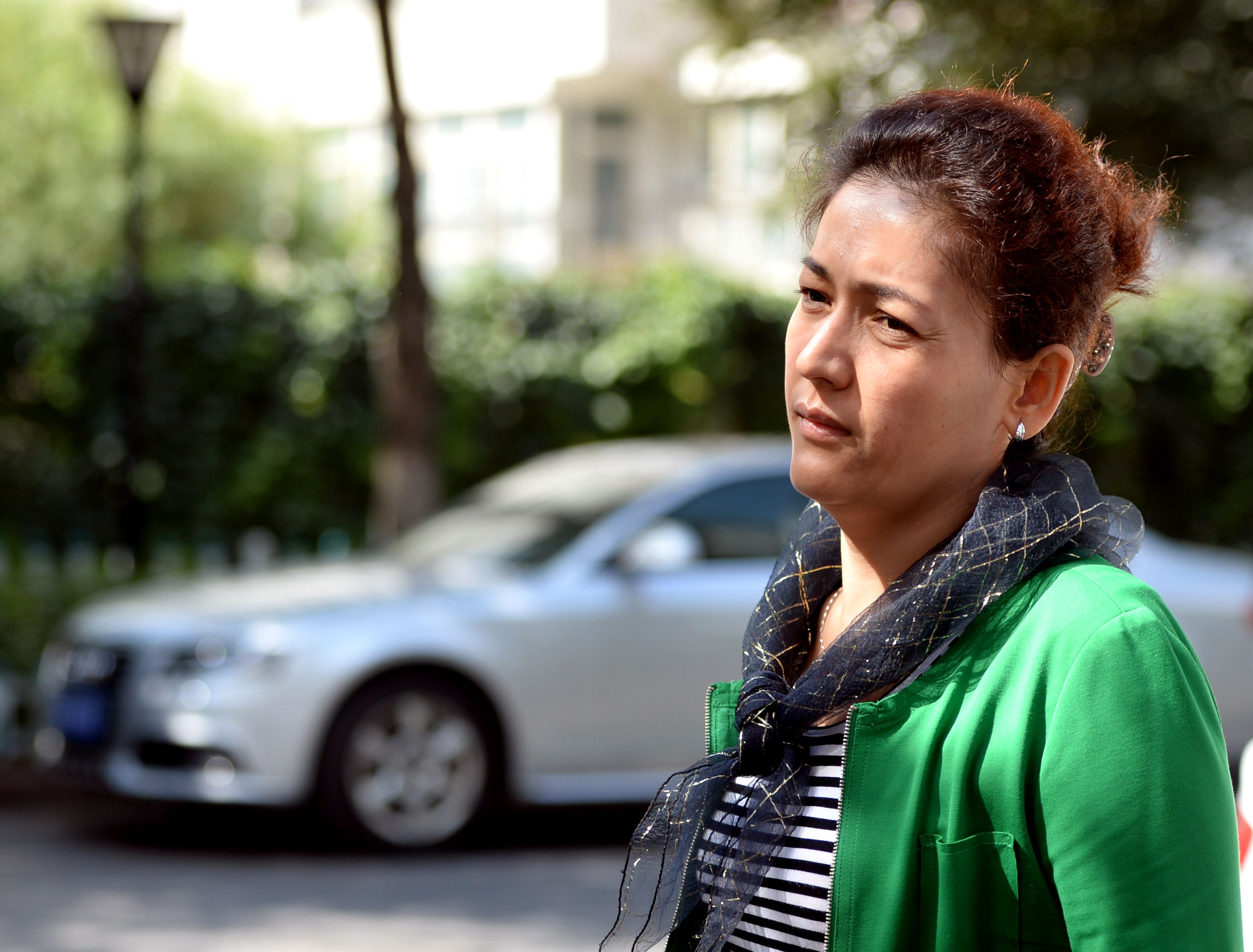
Tohti’s wife, Guzaili Nuer, says she is worried about her husband’s health. She is attending the trial with three brothers-in-law. Photo: AFP
Tohti’s counsel said on Wednesday that their client would deny the charges. Separatism charges can carry the death penalty in China, but the wording of the indictment means life imprisonment is the heaviest sentence Tohti can face, said his lawyers.
Prosecutors will argue that Tohti’s writings on his website Uygur Online, and his lectures at the Minzu University in Beijing, show that he was a leading member of a “separatist criminal organisation”, according to his attorney Li Fangping. In interviews, Tohti has stated his opposition to independence or separatism.
The defendant’s wife, Guzaili Nuer, has said he had health problems. She will attend the trial along with three of Tohti’s brothers.
Nuer complained she was continually tailed by security agents. “They follow me everywhere, they are outside my brother’s house as I speak,” she said.
“I’m worried about [Tohti’s] health, he has heart and stomach troubles, and he hasn’t been allowed to visit a hospital,” she added.
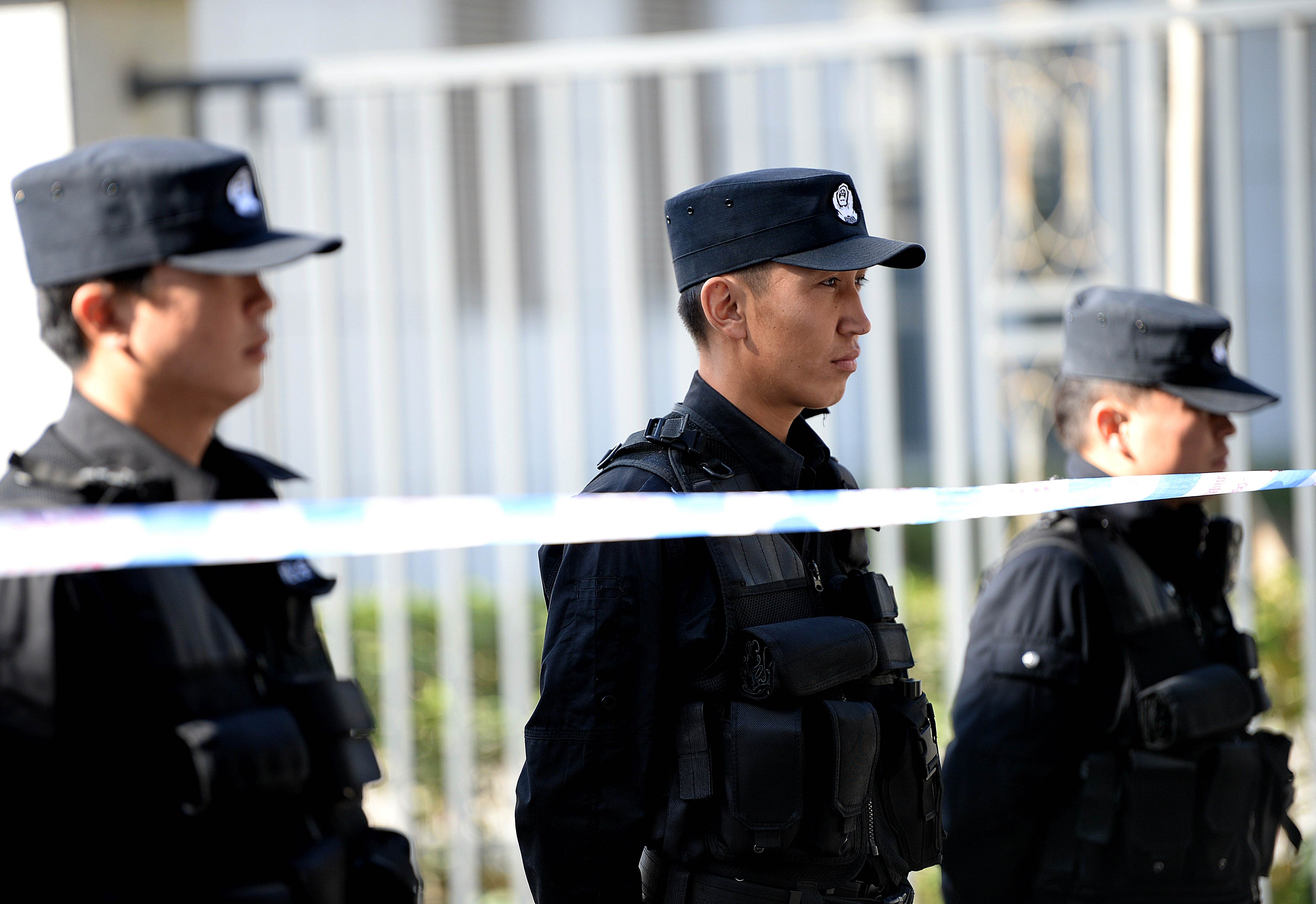
Chinese police seal off the road leading to the Urumqi Intermediate People’s court. Photo: AFP
His lawyers said he had been denied food and kept in shackles during his detention. Li Fangping said the scholar was shackled for more than a month while in prison.
Police formed a several-block perimeter around the venue with tape, keeping away journalists, bystanders and nine Western diplomats including from Germany, Britain and Canada who travelled to Urumqi, in China’s far west, in attempts to witness the trial.
Around noon, police blocked views of the street leading to the courthouse with eight tall panels promoting the upcoming China-Eurasia Expo in Xinjiang.
Several dozen police officers were stationed there, some in plain clothes and others clad in riot gear.
European Union diplomat Raphael Droszewski said the European Union expressed its deep concern over the indictment of Tohti, noting that he had worked “peacefully within China’s laws” and that the bloc has “urged China’s government to release him and offer health care”.
The trial is expected to last two days, but it was not clear when a verdict would be announced. Foreign journalists were not allowed inside, court officials did not announce any details and the court’s telephone number rang unanswered.
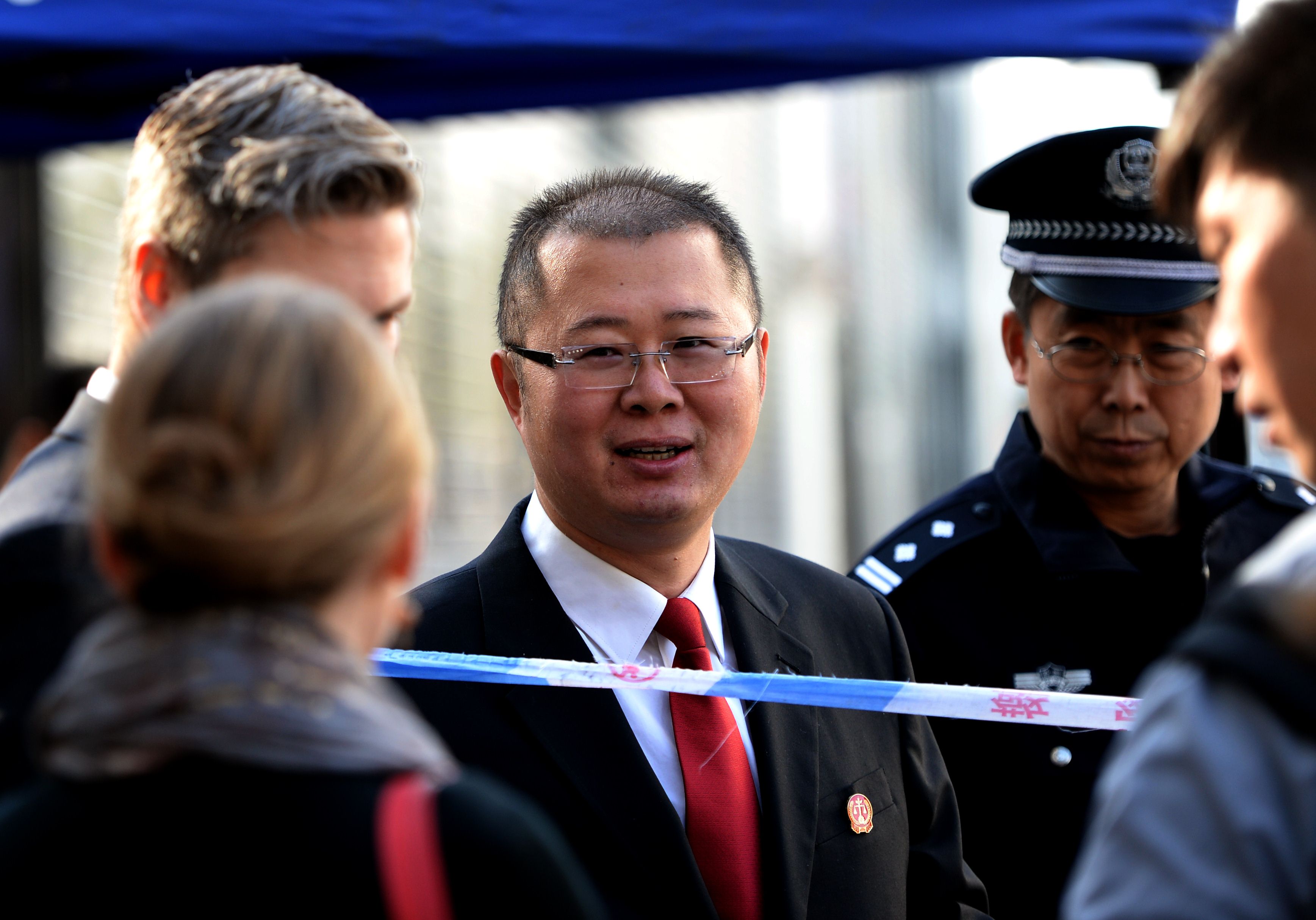
Foreign diplomats travelled to Urumqi to observe the trial. Some of them called for Tohti’s immediate release. Photo: AFP
Mainland courts are tightly controlled by the ruling Communist party and have a near-100 per cent conviction rate in criminal cases.
The United States, EU, and several human rights groups have called for Tohti’s release.
“Tohti has consistently, courageously, and unambiguously advocated peacefully for greater understanding and dialogue,” said Sophie Richardson, China director for US-based campaign group Human Rights Watch. “If this is Beijing¡¦s definition of ‘separatist’ activities, it’s hard to see tensions in Xinjiang and between the communities decreasing.”
Tohti was detained in January after he condemned the government’s response to a suicide car attack in Tiananmen Square which the government blamed on Xinjiang militants.
Tohti devoted decades to researching government policy towards Uygurs, about 10 million of whom live in Xinjiang, a vast, resource-rich and strategically important region which abuts central Asia.
As a professor and writer, Tohti was known for his moderate stance on Uygur issues but was repeatedly subject to house arrest and prevented from leaving the country.
Associated Press and Agence France-Presse

Leave a Comment